Haydn, Joseph
Back
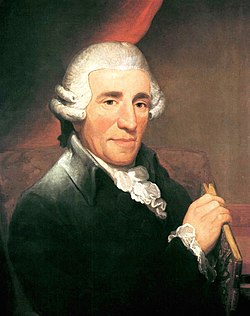
Image source
Wikimedia
https://en.wikipedia.org/wiki/File:Joseph_Haydn.jpg
Basic data
-
Haydn, Franz Joseph
-
March 31, 1732 in Rohrau (Niederösterreich)
-
†May 31, 1809 in Wien
-
Komponist
-
Eisenstadt, Wien, Eszterháza
Iconography


.jpg "St. Stephen's Cathedral. In the foreground is the Kapellhaus (demolished 1804), where Haydn lived as a chorister. (Source: Wikimedia)")


.jpg "Portrait of Joseph Haydn by Christian Ludwig Seehas, 1785 (Source: Wikimedia)")

_-_Franz_Joseph_Haydn_(1732-1809)_-_RCIN_406987_-_Royal_Collection.jpg "Haydn as portrayed by John Hoppner in England in 1791 (Source: Wikimedia)")


![Laus Deo ("praise be to God") at the conclusion of a Haydn manuscript[t] (Source: Wikimedia)](https://en.wikipedia.org/wiki/File:Page_729_(A_Dictionary_of_Music_and_Musicians-Volume_1).jpg "Laus Deo (\"praise be to God\") at the conclusion of a Haydn manuscript[t] (Source: Wikimedia)")

![Lithograph of Haydn from about 1830 (posthumous) by Adolph Friedrich Kunike. Landon describes the work as "a good likeness, showing him without his habitual wig (its source is uncertain—possibly the lost plaster bust by Anton Grassi [de], 1799)".[77] (Source: Wikimedia)](https://en.wikipedia.org/wiki/File:Joseph_Haydn_Litho_by_A_Kunike_Cropped.jpg "Lithograph of Haydn from about 1830 (posthumous) by Adolph Friedrich Kunike. Landon describes the work as \"a good likeness, showing him without his habitual wig (its source is uncertain—possibly the lost plaster bust by Anton Grassi [de], 1799)\".[77] (Source: Wikimedia)")


Documents
Biographical information from the WeGA
No biographical data found
Biography not available due to one of the following causes:
- Data will be added at a later stage
- Research of the WeGA was without success so far
- It is a well known person where enough information is available online elsewhere, see e.g Wikipedia